
For senior living communities
Assisted living orthopaedic care across the Fox Valley and Green Bay
On-site, non-surgical orthopaedic care for your residents — with no added staffing burden, no transport coordination and no administrative work for your team.
The problem we remove
When a resident's knee or shoulder pain needs an orthopaedic opinion, the cost to your community is rarely the appointment. It is the transport arrangement, the staff escort, the family phone calls, the hours a resident spends out of the building, and the disorientation that a long day out can cause someone with dementia.
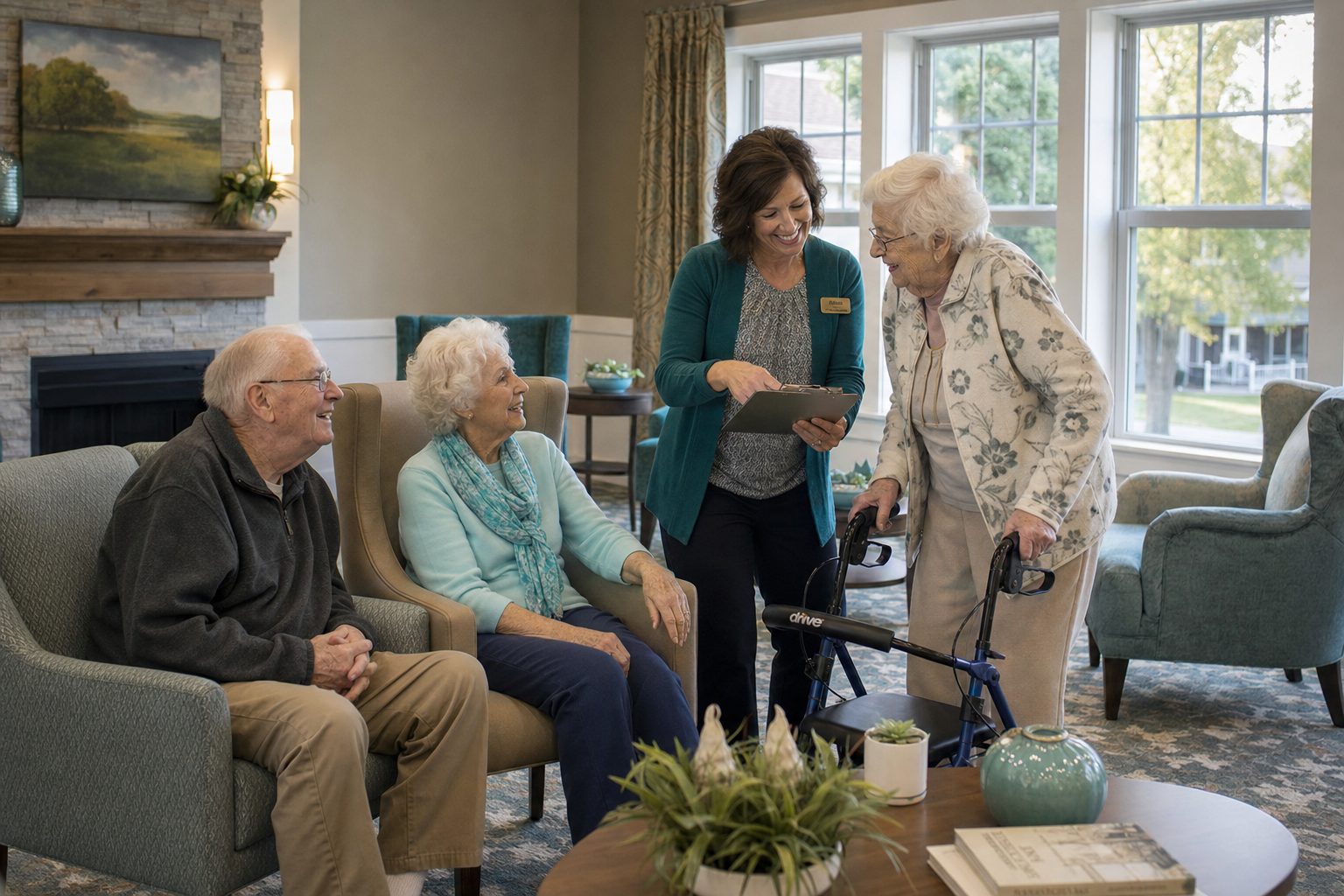
We come to the building instead. Eric Goddeyne, PA-C performs the examination, the ultrasound and the treatment on-site, in the resident's own apartment or a private common area.
Value to the community
What partnering with us changes
Fewer EMS calls and ED transfers
On-site orthopaedic assessment for falls and acute musculoskeletal complaints reduces reliance on emergency medical services and emergency department transfers for problems that do not require a hospital.
Lower transportation cost
No van scheduling, no escort hours and no lost afternoons for residents who need an injection that takes fifteen minutes.
No added staffing or admin burden
We bring our own equipment, supplies and documentation. Your team does not gain a workflow; it loses one.
After-hours orthopaedic consultation
Access to after-hours orthopaedic consultation for fall management and acute musculoskeletal concerns, so your evening staff has somewhere to turn other than 911.
Residents stay in the building
Familiar surroundings, familiar staff and no long day in a waiting room — which matters most for residents living with dementia.
Documentation your team can use
Visit notes provided to your nursing staff and to the resident's primary care provider on request, so the chart stays complete.
What we treat on-site
- Ultrasound-guided corticosteroid injections — knee, hip, shoulder, ankle, sacroiliac joint, trigger finger, elbow.
- Hyaluronic acid injections for knee, hip, shoulder and ankle osteoarthritis.
- iovera° cryoneurolysis for osteoarthritic and chronic nerve pain (self-pay).
- Assessment of post-fall musculoskeletal pain and chronic joint pain that is limiting mobility.
- Non-emergent, non-surgical fracture care and management, including imaging ordered or coordinated on site.
- Assessment of the joint pain, weakness and equipment problems that contribute to falls.
Non-surgical fracture care, on site
Not every fracture needs an operation, and not every fracture needs a trip out of the building. We manage non-emergent, non-surgical fractures for your residents: the examination, the imaging, the management plan, the follow-up visits, and the judgment call about when a surgical opinion is actually warranted.
Imaging is ordered at your facility where that is possible, or coordinated so the resident is imaged with as little disruption as we can arrange. Your staff does not chase it and the family does not organize it. When a fracture does need operative care, we say so and coordinate the referral rather than sitting on it.
Emergencies are still emergencies
Acute trauma, an open or grossly deformed fracture, a suspected hip fracture, a dislocation or a resident who is unstable goes to emergency care — call 911. Our role begins once the situation is non-emergent and it is clear the injury does not need the operating room.
Fall prevention is a focus of ours
Falls drive your incident reports, your hospital transfers, your survey exposure and your hardest family conversations. A large share of what we already do on site works against them: treating the knee, hip or ankle pain that makes a resident unsteady, assessing gait and strength and range of motion during the visit, and looking at whether the walker or cane a resident is using is the right device, correctly adjusted and actually being used — assessed in their own room and hallway rather than in a clinic, which is the only place that answer is real.
We are also building out a more formal fall prevention program, including a pharmacist-led review of medications that raise fall risk. That piece is in development and not yet live, and we would rather tell you that than describe something we cannot deliver today. If structured fall prevention is a priority for your community, say so on the partnership call — we are shaping the program around what facilities actually need.
How a partnership starts
A conversation with your leadership team
Fifteen minutes on the phone covers scope, scheduling, documentation and how residents and families are informed.
An agreed visit rhythm
Scheduled recurring visit days, or on-request visits for individual residents — whichever fits your census and your resident needs.
Consent and coverage handled per resident
Each resident (or their authorized representative) consents individually, and coverage is verified before treatment.
Facility contact path
Administrators, directors of nursing and wellness directors: call (920) 777-9876 and say you are calling from a senior living community, or email info@mobile-therapeutics.com with “Senior living partnership” in the subject line. We will get back to you with a partnership conversation rather than a sales pitch.
We work with communities in Green Bay, Appleton and the Fox Valley, Oshkosh, Neenah and Menasha, Manitowoc and Two Rivers and Sheboygan County.
Individual results vary. No treatment guarantees complete or permanent relief, and every plan starts with an examination and a conversation about your goals.
Talk to us about your community.
Call (920) 777-9876 or email info@mobile-therapeutics.com. We will walk your team through scope, scheduling and documentation.